
Cause & Effect Aren't What We Think They Are

The kettle was doing its thing there this morning, that low muttering yoke it does, trying to gather its energy to make itself boil, like your auld lad complaining about the price of oil because billionaires are using a war to hide their pedophilia, and I, barely present, am flicking through an old notebook I’d no business opening before caffeine.
This is how trouble starts, looking for ideas for articles, delving back into what I thought was interesting a few weeks ago, wondering if I’ve progressed at all, regressed, or just gotten older, and rounder?
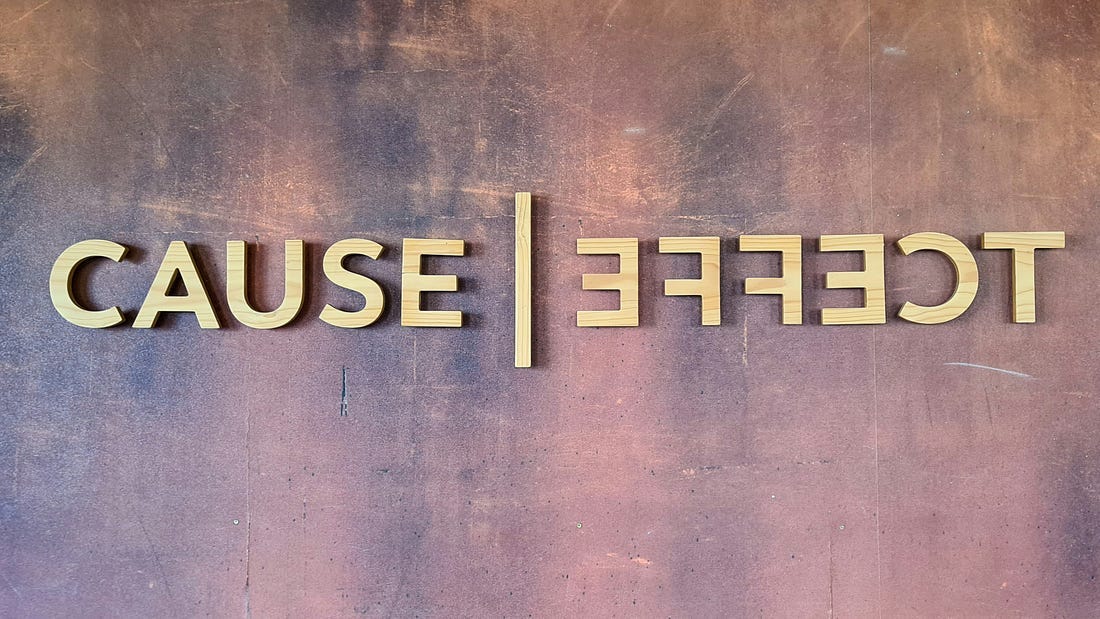
But there it was, scrawled in my purple pen: “David Hume’s most dangerous idea: cause and effect is an illusion.”
I gandered at it for a while, trying to remember where I’d gotten it from, what video I’d watched, what article I’d read, what it was about that caught my dopamine-addled attention.
The kettle whistled like a demented train, and the house made its usual small noises; possibly it was the dog passing gas. Beyond the fence, the seven sausage dogs that my neighbors were barking and fighting and howling at a squirrel bolting up a cherry tree and, and look, those dogs are individually lovely, but Christ on a bike, they do love to make a racket, and I’ve yet to see them ever catching a squirrel they were bought to do.
Learn more about this article’s writer, Paddy Murphy, here.

And sure look, God help us all, ’cause and effect is an illusion,” is a mighty sentence to find beside an old reminder to buy batteries and bananas.
David Hume, the Scottish philosopher and historian, had an odd talent for making ordinary life feel suddenly unstable on its foundations. He looked at cause and effect, and asked a bit of a rude question. What do we actually see when we say one thing causes another?
I had to make this simple so I could really get it.
Let’s say that a flame touches paper. The paper burns. A snooker ball strikes another ball. The second ball rolls away. A man drinks far too much whiskey and wakes up with a head like a cabbage being attacked by crows. We call these things cause and effect because we’ve seen the various patterns before. Hume’s trouble begins with the wee gap between the events.
With the above, we see the flame, then the burning. We see one ball move, then the other. We see the drink, then the doom. We never see the invisible glue.
We never see “necessary connection” itself strutting across the room in a waistcoat, saying, “I did that” in its TED Talk. Maybe that’s a bad reference; you don’t see many TED Talks now. What happened to them?
Edit: Ahh, found the video, have a look…
Anyway, let’s have a look at that dangerous wee gap. Hume says the mind fills it with habit. The past trains us, and so repetition teaches expectation.
The world turned, and so the sun rose yesterday and today, so we expect it to happen tomorrow. Fair enough. I, like you, have curtains for the evenings so that our neighbors can’t see me picking my nose while watching Premier League football under soft LED lights. I live by this assumption like everyone else. Hume was no eejit either. He wasn’t the type to advise people to test skepticism by walking into morning traffic.
Still, y’know, the idea nags at me.
Isn’t most of what we call certainty just memory with a loud voice? That’s all well and grand for things like kettles, fire, food, gravity, and the wall-scraping, paint-scattering consequences of trying to move a wardrobe without first measuring the stairs.
And it becomes way more problematic when we turn the same machinery on ourselves.

The word that puts people in chains
“Because” is a small word with a hidden blade in the toecap, like the baddie in Bloodhounds, that Korean thing Netflix kept pushing on me until I watched it — great fighting scenes, in fairness.
“Because” can cause awful problems.
Because she left me, I’m unlovable. Because I failed, I’m feckin’ useless. Because I was ignored as a child, love will always abandon me. Because I felt panic in a football stadium once when I was eight, panic is waiting around every corner like a debt collector in a bad coat. Because my mother had that tone. Because my father said nothing. Because the lads laughed. Because the room went quiet when I entered.
The mind loves a courtroom drama more than your granny loved Matlock. It wants motive, culprit, sentence, and the finality of the bang of a gavel.
Give it one awkward silence, and it will summon all the witnesses to the time your shorts split at a birthday party back in 1989. Give it a whiff of disappointment, and the crafty so-and-so will bring in childhood, genetics, weather, class, sin, diet, and the fact that some second cousin on your mother’s side once tried to kiss you at a disco. Panic, indeed.
It would be funny if it didn’t hurt people so much. I wonder, how much suffering comes from treating associations as universal laws? A person gets wounded, and years later, the wound is still writing daily doctrine.
The body recognizes danger, and the mind, because it can only call upon past experience, calls that danger truth. An old shame rises, and the self bows before it as if it were scripture handed down from the Mount by a choir of angels.
This is where Hume becomes unexpectedly useful. Hume says, “Oi lad, look again.” Are we seeing an iron law of reality, or are we just seeing a repeated pattern?
That question matters in therapy. It matters in grief. It matters when someone is trying to build confidence from the ruins of an old insult. A client may say, “I’m afraid to speak up because the last time I did, it led to failure.” The sentence has history in it. It has truth in it. Yet it may also have a door in it, if you can find the hinge.
The past shapes us. Of course it does, that’s bloody obvious. Only an eejit with a Shure podcast microphone and a supplement code would say otherwise. Still, shaped doesn’t mean signed, sealed, delivered. The past leaves marks, yes, 100 percent, but it doesn’t have to get the final vote.
East we go
That is where Buddhism comes in, though I can already hear some fella saying, “Ah, here, we were only talking about Hume, and now you’ve dragged in monks.” Yes. I have. Sit down.
Siddhartha Gautama, what his auld one called him, known to us as the Buddha, taught that suffering arises through conditions. Buddhism speaks about dependent origination, the way things come into being through relationship and circumstance.
In the twelve nidanas, Buddhist teaching describes how ignorance, feeling, craving, clinging, identity, and suffering can feed one another until a passing mood becomes a life sentence.
Here are two videos about the Nidanas, the first coming from me auld mucker Tommie Kelly and his collaboration with Duncan Barford, where Tommie made an oracle deck…
That’s the part worth sitting with. A feeling appears. Maybe loneliness. Maybe fear. Maybe the sour little sting of being picked last for football during lunch break, or even worse, being left out. Then craving comes. You want the feeling gone, or you want someone to fix it, to praise you, to choose you, to text you back, to absolve you from the grave of your own mood. Then, clinging arrives, the real nasty sod. You cling to the story because at least it is yours.
Soon enough, the unconscious mind, which doesn’t have the same logic that ‘we’ do, has turned a passing, temporary, fleeting state into a permanent title. I’m lonely. I’m broken. I’m depressed. I’m cursed. I’m the sort of person this always happens to.
That last one is a killer. Now you’re both the hero and victim in the story you’ve let yourself believe.
Buddhism is often mistaken for fatalism by people who have heard three quotes and bought a discounted plaster statue in a garden center. The deeper teaching is that if suffering arises through conditions, then changing conditions matters. Sleep matters. Speech matters. The Company you keep matters. Food matter. Thoughts matter.
What you rehearse in the mind matters. What you keep feeding with attention matters.
Karma has been mugged by the gift shop
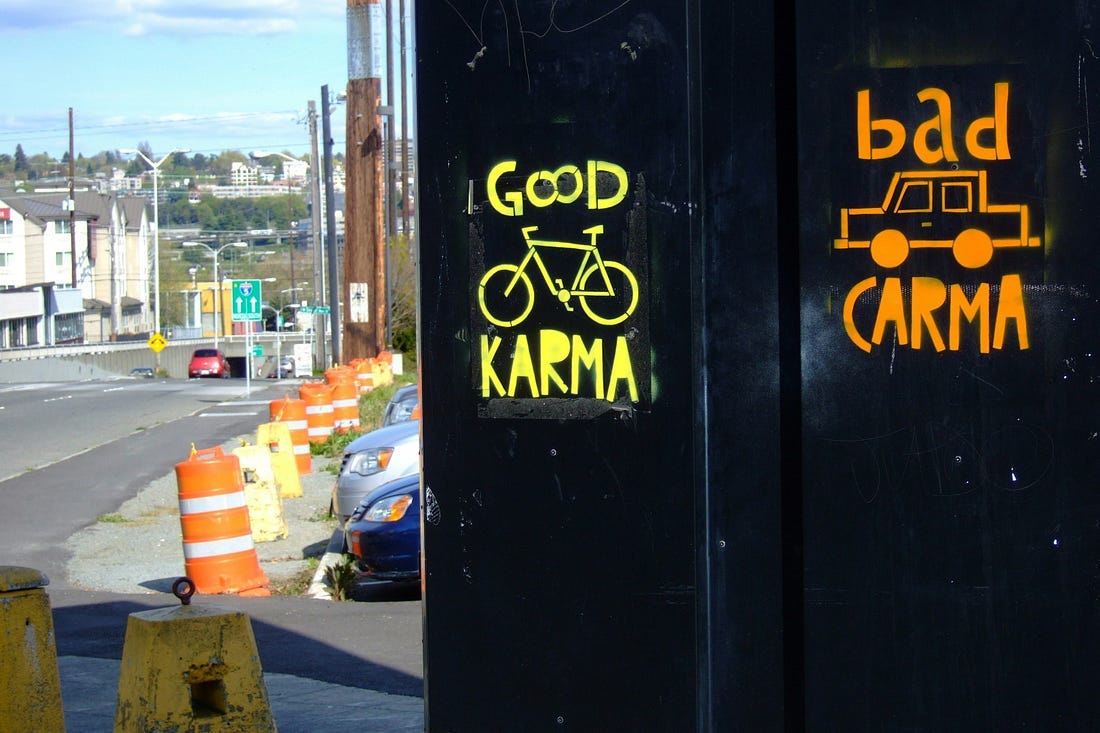
The idea of karma suffers from bad public relations. In the West, it’s been dragged through scented candles, fridge magnets, smug captions, and pub justice.
Someone cuts you off in the LIDL car park and later reverses into a bollard. Karma, haha, you laugh, all delighted that you’ve seen some cosmic justice doled out. Some lad acts the Casanova for years and then gets caught with his pants down with the barmaid in the local. Karma. A politician lies and is swallowed by his own scandal. Karma. Aye, emotionally satisfying, no doubt. We like the universe with a bit of Laurel-and-Hardy slapstick in it.
But there’s a massive problem when people use karma to explain suffering, as if it were deserved.
That is vile. Holy language can become cruel when it loses tenderness.
In many Indian traditions, karma means action and consequence. In Buddhism, intention has great weight. Karma concerns what intentional actions do to the mind, to character, and to the conditions of future experience.
If you practice bitterness, spite becomes second nature. If you practice deceit, the world becomes a room full of people looking to pilfer the pennies in your pockets. If you practice compassion, you alter the air around you. This has nothing to do with the universe keeping score like your bitter aunt Gertrude at Christmas and her constant moaning about gender-neutral bathrooms — she’s still looking at me from when I told her I had three in my house. Goddammit, Gerty, every household bathroom is gender neutral, ya daft dolt.
What I am circling around, badly perhaps, is this: the straight line is often the lie. Human beings adore the straight line because it makes pain legible.
This happened because of that. I am this way because of what happened to me. She suffered because of her karma. He failed because of his weaknesses. They are poor because they chose badly. I’m anxious because I’m defective.
The straight line comforts the frightened mind. It also brutalizes people.
Life is usually more crowded.
This is where Hume and Buddhism meet in my head, though neither asked for the appointment. Hume loosens the arrogant certainty of cause and effect. Buddhism shows how suffering gathers through conditions.
The tea is long gone cold now. I’ve left the leaves in it for longer than is accepted by most, and I don’t have it with milk. I like my drinks to have a hint of suffering to them, and the day is going on around me.
The bosswoman’s getting ready for a client, the dog’s still farting, I swear to God he’s smiling about it too, and the squarrels are still blowing raspberries at the sausage hounds next door, and inside my auld noggin, the mind keeps clanking away, linking this to that, making laws from bruises, mistaking habit for prophecy.
But I’m present here, and I’m not obeying it: I’m simply here noticing the machinery while it’s running.
Liked this? You’ll like my book, The 5 Keys Of Confidence. Available as an eBook or a paperback.
I’m Paddy Murphy. Thanks for reading my article. I’m a writer and mental health counselor. Learn more about me here. Social media links here.
Donations link: https://ko-fi.com/murfowski